Saturday, September 22, 2007

Collapse

I might have been gone for a while, but the title is not about the state of this blog. Rather, it's about the book I've mentioned in my previous entry.

I first got interested with Jared Diamond's Collapse upon seeing the Mayan ruins on its cover and reading the subtitle "how societies choose to fail or succeed." I figured it would be a good research material for the "epic novel" I have in mind, as well as additional information concerning 2012. Well, I never got those things I was looking for, but I still got quite a learning experience.

For the past few weeks, I underwent a re-education in history, at least those of the sample ancient and contemporary societies as Diamond examines their rise and fall or survival through the interplay of five variables, namely: damage inflicted by the society to its environment, climate change, hostile neighbors, friendly trade partners and the society's response. Indeed it is a novelty for most people to view history in terms of the environment, for history is more commonly associated with the social sciences like politics and culture (although the book also takes these aspects into consideration). This multi-disciplinary integration, which lends itself to Diamond's majestic big-picture exposition and analysis, is what I, who would like to think of myself as a jack-of-all-trades, personally like about the book.

Now what could make societies collapse? Four of the five variables are considered givens or things of the past and merely determines, at a specific point in time, how brittle or robust a society's environment is. Diamond gives weight to the fifth, society's response, the only variable where people can be in considerable control. It boils down to problem solving, specifically the steps involved: anticipation of a future problem, perception of an existing problem, creation of a solution and the result of that solution. Failures could arise at any of those steps, and the reasons for such failures may be foolish in hindsight, but on second thought are arguably rational or excusable. Who would fault those who take care of their own interest? How would people notice the decreasing amount of resources if it happens slowly over generations, especially if they are not trained to detect these changes? Why would people suddenly discard traditional values that have defined their society and have made them successful throughout all these years? These are hard and troubling questions because they go deep down into our very selves, our identities, our beliefs, our values. One would think that, despite the intellect and advancements, humanity is still limited, finite and, perhaps, ultimately doomed.

I myself would, for instance, insist that technology will be able to solve our problems sooner if not later, but even to that Diamond has a response: time and again technology had solved some problems only to introduce new ones. Should I then despair, especially now that technology is sufficiently advanced to trigger problems more massive in scale?

No, the correct response is to be humbled and to be hopeful. The fact is, we're still alive after all, in spite of catastrophic failures in the past, and current pressing problems. Among the sample societies in the book, there are success stories from various societies employing various means to adapt and preserve themselves. The human intellect, the knowledge collected throughout the millennia, the advancements though short of perfect will, if used properly, be enough for us to survive. That was one reason why Diamond still wrote the book. He still has faith in the human capabilities, flawed and puny they may be, to still deliver us to survival.

-oOo-

Collapse is written by an American for an American audience. However, the few mentions on the Philippines aren't exactly flattering. Most noticeably, Diamond lumps the country, together with Indonesia, Afghanistan, Iraq, Somalia, Madagascar and Haiti as environmental hotspots of the world. Interestingly, he then notes to drive his point, in this same group of countries are also the political hotspots of the world. (Aside from Indonesia, where are the other East Asian and Southeast Asian countries? On their way to First World status, although Diamond points out that being First World, with its wasteful lifestyle and "exported" environmental damage, is not entirely a good thing.)

Another unflattering mention of the country in the book is about short-term lease logging that is damaging the rainforest. We're not talking of illegal loggers here; short-term leases for logging are granted by the government to companies in exchange for taxes and fees. However, the tendency of the logging companies is to acquire as much lumber as they can, and after the lease expires they can actually just run away and renege on their commitment to replant. I remember how, in the year 2004--when Diamond is probably in the thick of writing this book--massive landslides brought about by record amounts of rainfall have wrought destruction at Quezon province, while fallen logs accompanying the mud and flood revealed the culprit. There was this sound and fury regarding a total log ban, which eventually fizzled out. Then the following years saw an increase in the frequency of landslides. Have the loggers already inflicted upon the Philippines the damage they, as Diamond mentioned, already inflicted upon the Malay Peninsula? What could happen next to this poor country of ours?

There was actually one good thing Diamond had mentioned about the Philippines, and it involved sustainable practices, at least on a community level. It was buried somewhere along the footnotes for further readings, though, and can be easily missed. How come we cannot do this in a national level?

-oOo-

I this point I should restrain myself from again proceeding with my usual kilometric ramblings. The temptation is great since, Collapse contains lots of information and realizations that would keep me going. But then, I just might as well re-write the book!

Labels:

CLICK HERE FOR THE REST OF THE ENTRY

Saturday, August 25, 2007

Drought

In one way, this title can well describe the recent state of my blog. At the surface, there is no new entry to quench the thirst of the handful of readers out there. Yet like the country's recent drought scare, in my mind clouds of thoughts have been gathering, building strength to inundate my blog with my usual kilometric posts.

Speaking of this recent drought scare in Northern Luzon, I can't help but twit with the responses of the nation's leaders to the crisis.

It was already July, yet this year's rainy season hadn't officially kicked in, at least in Northern Luzon. Sure, there were some rains in Metro Manila, but they were too few in the places that matter. Consequently, the water levels in the dams up north of the capital continued their descent, even breaching their respective critical levels. This in turn threatened both the irrigation of vast agricultural areas in the region, which is a great contributor (40% if I'm not mistaken) to the agri-economy, and the energy output of hydro-electric power plants, which were churning out electricity to power the fans and aircon of city-dwellers still inconvenienced by the extended sunny weather.

The government then began sending out emergency funds to mitigate the farmers' losses, step up cloud seeding operations as well as ordering extra coal so that the expensive and polluting coal power plants could shoulder the energy production, which the dams had been rendered incapable of generating. Officials also mouthed reminders to conserve water so that there would be no interruption of its supply for general consumption. The problem appeared to be compelling enough that Church leaders issued out an oratio imperata, a call to prayers for more rain (made more profound because of the Latin, ah but of course: "quid, quid latine dictum sit, altum videtur").

As if on cue, starting just mere days later, three successive typhoons passed by the Philippines. They did not hit the country directly, but instead strengthened the monsoon and brought in more rain. Too much rain in fact for the places that did not need it. It was as if God decided to humor the prayers of the flock when he sent in the typhoons. It was as if the reason He delayed the rains was because the people were not yet ready for the flooding, the disease, the potholes and the falling billboards, among others.

It makes me wonder what would happen if the typhoons started coming only after more than a month since the call to prayers. Or maybe the bishops had been assured, after a long hard look at Pagasa weather data, that a storm may form in a few days, thus they issued the call ad majorem Dei gloriam.

Pathetic. My first impression of the bishops' response is that it is medieval (not surprising though). The government's call for water conservation was a lot better, but considering the other things it can do, I deem as feeble the overall government response (also not surprising).

I would be impressed if the government would use this crisis to push for long term measures to counteract water shortages, boost food security and ensure uninterrupted energy production. I'm not knowledgeable on what exactly are the measures are most fitting for the Northern Luzon area, but I'm sure reforestation and logging control are included. Buried in the news, but also vital would be the DOST/UPLB research for an irrigation system with minimal water usage. Instead, the government focused more in reactive moves like cloud seeding, emergency purchases and emergency funds. Oh well, as I've learned long ago, I shouldn't expect nor depend much from the government. If they push for those long term measures, they would be stepping on the toes of those with vested interests, and for an administration concerned with its survival, this could be a disaster that will impact them much more than natural disasters of which they think they are insulated.

On the other hand, I would be even more impressed, if, in a very simple move, a move as easy as creating daily homilies, a move that would only be opposed by those with vested interests at their own risk, the clergy starts mouthing off that caring for the environment is a moral duty for every devout Christian, that this is backed by a number of Bible passages from the Book of Genesis up to the Book of Revelations. They actually had the chance one Sunday during the height of the water crisis when the Sunday Gospel was an admonition against greed: Jesus told a parable about a rich landlord who decided to build bigger warehouses to amass more harvest only to be told that he will cease to live the next day. It was the perfect opportunity to impose upon the consciences of the faithful that the human penchant to consume more than is needed is a sure way to strain and eventually deplete natural resources, leading to a collapse of the society wherein its members would suffer gruesome deaths from starvation, warfare, disease, crime, natural disaster, etc, take your pick.

I've intimated about these things in my previous entries here and here, but this time I am more sure of where I'm coming from after reading Collapse by Jared Diamond, Pulitzer Prize-winning writer. Because in this book I find some of my armchair speculations and conclusions about humans and the environment validated and backed by the 70-plus-year-old author's lifetime of research and experience.

More on the book in my next entry ;)

Labels: ,

CLICK HERE FOR THE REST OF THE ENTRY

Friday, December 29, 2006

Remembrance of the Wave

It might have been noticeable that, aside from revealing my fascination for the End Times, I have delved in Apocalyptic themes recently. It happens whenever I'm pissed off enough to rant. I guess, in my helplessness, I resort to the eschatological and seek the ultimate justice. Before everyone gets fed up with this fear-mongering, allow me one last venture into the supernatural, at least for this year.

Last November 13, 2004, I received a forwarded email, the screenshot of which is shown below...


Well, at first glance it looks like one of those dire predictions of the future. By the way, part of that email, which isn't shown anymore, is an article from Phivolcs. This more scientific earthquake projection which coincided with the prediction is what pushed the original author to finally spread the word. What impresses me is that the prediction imposes a deadline: before the year 2004 ends, there will be a great earthquake that will devastate the Philippines, or Luzon to be a bit more precise. Furthermore, there is the claim: the old man has never missed.

I initially surmised that this should be a very strong earthquake, stronger than any other quake before it, to topple down every building in an area and erase an entire town from the map. Anyway, I shrugged, if ever it would happen by the end of the year, I might already be vacationing in Bicol; thus, I would be spared from its full force.

The old man was off by a few thousands of kilometers, and I was more precise with the timing of the event.

I was eating breakfast at our Naga City home when news of a magnitude 9 tremor from CNN Breaking News got my attention. A magnitude 9 earthquake was really strong, the strongest I had heard of in my twenty years on this earth; still, I didn't think this can flatten all buildings within its area. That may be true, but there was something else that I hadn't thought of. Hours later, CNN reported of a tsunami from that quake hitting Thailand and Malaysia, and later still in the afternoon, the same tsunami hit India. Upon the news anchor's query, the scientist at the US Geological Survey related this recent turn-of-events to a Pacific-wide tsunami decades ago. That was the time I had an inkling that this was something big. Later, the waves reached Africa.

The days passed and the kill count grew from hundreds to thousands to tens of thousands. Now it was really big. More than a week later, with the kill count pushing a hundred thousand, ground zero was finally reached by rescuers. As shown in before-and-after satellite pictures, the town of Banda Aceh was in complete ruins, erased from the map as the old man had said.

I guess the old man really did see beforehand these visions I saw in the TV screen. It was just he mistook the similar-looking Southeast Asian faces and places to be Filipino.

Labels: , ,

CLICK HERE FOR THE REST OF THE ENTRY

Saturday, December 09, 2006

Wrestling with the Wind (Part 3 of 3)

Oh great, this third and last part got postponed for a long enough period to have two more super typhoons pass the country, with the latest, Reming (Durian to the rest of the world), almost threatened another destructive episode right here in Metro Manila. In fact another one is upon the Philippines, Seniang (Utor to the rest of the world), threatening a deluge to compensate for its not-so-strong winds.

Rants

Back to Reming, good thing this latest cloud spiral of doom decided to change course. Else the metropolis will once again get plunged to darkness. Once again the massive power failure would affect the water supply for most parts. How long would another round of deprivation last? Nine days also? Two weeks? When Naga City was struck by Milenyo, with greater intensity than Metro Manila, mind you, they got their electricity back in two to three days. This "provincial city", like other "provincial cities", beat any NCR city by days in fully restoring power to their constituents. How's that for "Imperial Manila"? They can't even back their haughtiness up!

In fact, Meralco kept proclaiming in the news, after more than a week, that they got their systems 99% restored. Was this godforsaken kilometers long stretch of darkness and dryness along C5 composed mostly of military housing and squatters a mere 1% for them? One percent of income I presume? Let all of them suffer, Meralco must have implied when they de-prioritized repair in those areas, as punishment for them having some people that had stolen the cables that would have made the restoration work a lot easier, faster, cheaper, cheaper and cheaper. Let them suffer, these people who had, for the longest time, connected illegally to the grid. What kind of reasoning is that? It's like Globe refusing to repair a bombed-out cellsite because the people in that area have allowed the NPA to flourish or cutting the signal around an area because of too much fraudulent activities. At the very least you do not hear Globe whine openly in media about such NPA-infested areas, and proclaim them de-prioritized. So Meralco is more "honest" then? It's not that I would condone the stealing of the cables and electricity, but should we law-abiding citizen's whose only real fault was to be neighbors with these lowlifes be made to suffer as well? Should we who refused to participate in the orgy of stealing be accused of condoning them? Why not recognize that we are helpless as well, that we can be threatened by these thieves into submission.

That was just for the electrical shortage, but what irked me more was the loss of water. Electricity had only been harnessed by humanity for no more than 200 years, but water has been part of human existence ever since the start. Thus the need for it is greater, more primordial. Water entrepreneurs made a killing with their delivery services for the nine days we had no water. I have no beef with them. Even if they jack their prices up I understood them for they are merely following supply-and-demand tenets. Besides, they are doing honest labor as they pedal around the complex and carry liters up the stairs. What raised my blood pressure was our housing administration that had no qualms of violating laws just to earn a few tens of thousands of bucks per day aside from their usual racket of additional charges for every utility that enters the housing complex. Some wise guy in their hierarchy had the great idea of wrenching open the fire hydrants in our neighborhood. Then they charged hapless residents of a few pesos per gallon with the reasoning that these hydrants pass through their meters. Bullshit! The mere fact that these hydrants had water while the water pipes in the housing complex were dry as a desert makes that assertion doubtful. Besides, these are fire hydrants, to be used by firefighters in case there's a fire. These lucky bastards should be thankful nobody raised this charging of water from a hydrant to the Bureau of Fire Protection. Why not power instead the pumps of the housing complex with generators, wise guy? Oh, that would be costly; all the profit from the rackets will be lost. Yeah you're a wise guy indeed, asshole!

You've noticed I haven't talked about billboards yet. That's because it's the one topic that has been talked to death in public. I'd rather talk about the fallen trees, and fallen lampposts. See how much of those trees were shallowly-planted in some half-hearted attempt to comply with environmental or aesthetic standards, which were feeble in the first place. Similarly, the shallowly-planted lampposts on the other hand are testaments to half-hearted--no, heartless public service (read the book Pork and Other Perks to find out what I mean). Well as for the billboards, I've been observing the humongous one in Guadalupe. Its first ad after Milenyo displayed the image of Our Lady of Guadalupe. It reminded me of how people turn to God once they start feeling their mortality. The next ad, after the billboard reduced its height by about two meters, had Manny Pacquiao on it. So, they'll fight it out now, huh. When Pacquiao furled up under the threat of Reming, the next ad to be unfurled declares the "power of beauty" or something. Great shades of Imelda!

It really was good that Reming changed course. It's not so much the natural disasters that make me bristle, but the man-made disasters that follow it.

Sermon

It makes me think on how Sodom and Gomorrah was actually destroyed. Was it the raining of fire and brimstone that destroyed those cities? Or could it be how the people reacted afterwards that did them in? Maybe that was why Lot was not allowed by God to look back at the city while it was being destroyed. Maybe God did not want Lot's eyes to be defiled by witnessing what the people were doing to each other and not by what the fire and brimstone was doing to the city.

But there is hope. Remember what God promised to Abraham while the patriarch was bargaining with Him about the fate of the sinful city? God said that as long as a few good people remain, the city will be spared. Same thing with Nineveh, when the people changed their ways after hearing from Jonah, the city was spared. Again, before that, didn't Jonah give up on Nineveh upon learning of the prophecy? Could've Jonah seen a cataclysm that was inevitable, like a tsunami, a typhoon, a meteor barrage? Perhaps disaster still visited Nineveh, but because the people have changed, those who survived managed to rise up after the calamity by sheer power of a true community rather than succumb to selfish interests and ultimately, destruction.

Perspective

You think Metro Manila's experience of Milenyo was bad? Remember that it is usually the Bicol Region that faces the full power of a typhoon fresh from gathering power over the Pacific Ocean. And in Bicol, it is usually the province of Catanduanes that has the unwanted privilege of being the first province to meet the howler head-on. Furthermore, being in a remote area, the aftermath could be something like this.

In the aftermath of Reming, this region's unfortunate circumstance has been highlighted once again. This latest super typhoon might rival Rosing in terms of the destruction it has wrought in Naga. But more than that is the tragedy bestowed upon the neighboring province of Albay. It was less than half a year ago that the people in charge have handled with flying colors the disaster mitigation in the light of a restive Mayon Volcano. It is frustrating now that they are left with about 500 dead (possibly more) from the sliding of volcanic debris from the otherwise beautifully inclined slopes of the volcano. As if, in some sinister improvisation, Mt. Mayon was merely waiting for a typhoon with diluvial rains to dislodge the debris it earlier deposited on its slopes, in the end the mystical volcano again pulled a fast one on them.

Help them please, please.


Other parts of the series:
1 2 3

Labels: ,

CLICK HERE FOR THE REST OF THE ENTRY

Sunday, October 22, 2006

Wrestling with the Wind (Part 2 of 3)

In the aftermath, trees, billboards and electric posts were felled by the treacherous gusts that blew like a boxer's punches. Hours of no electricity extended into days. Without electricity, the pumps in our housing complex were useless, leaving us waterless too. Yet this is Metro Manila, and these were really no big inconvenience. The malls were up and running on generators. These commercial edifices were more than willing to placate the boredom, heat and material needs of the urban dweller. The planes were flying as soon as the clouds thinned over the airport and its environs. The next day, I was actually able to commute to to the office without any major hitch. Metro traffic was back with a vengeance (buses made a killing while the MRT was offline). As far as I was concerned, the Globe signal never went off even at the height of the typhoon. Lastly, one significant factor that alleviated major discomfort in our place was the absence of floods, the perennial scourge back in Bicol. No muddy floor to clean up, no damaged furniture and appliance to repair.

After Rosing back then, with extensive damage to city infrastructure and utilities requiring about a week to fix (or wait for reprieve from nature, in case of flooded areas), our semestral break was extended to seven more days (oh joy!). It was impossible to be bored. The flood had shaped a new landscape of mud and sand that was conducive for play. We drew figures on a mud dump like what we did once on still-wet cement. There was even one poor boy whose body figure was embedded on the mud because the bullies made him fall flat on his face (and we thought we'd see that only in cartoons)! It was exploration galore! Rosing was so strong it took with it the remaining clouds in the region, leaving us with sunny blue skies by day and clear starry heavens by night. Our group of friends became instant astronomers as we identified constellations, stars and planets, and even spotted the occasional meteor and high-altitude plane or satellite. During the hot and humid days, we would seek shelter around the trees that withstood the typhoon or inside makeshift tents put up by our neighbors who had the misfortune of living in low-lying areas where the flood had not receded yet. I must have learned a handful of card games that time (which I eventually forgot until I encountered them again in college). The most monumental discovery of that time was a stash of comics found in one of the tents. Because of this discovery, we, pubescent boys and girls, even formed a "Midnight Society" wherein we met at a fallen tree by the bank of the Naga River whose waters were deep and fast-flowing (the source waterfall suddenly appearing as a white strip on Mt. Isarog, 15 km. away, the gentle stream swelling to a raging river up there). We didn't meet at midnight, we preferred the hot and lazy mid-days and afternoons. In the first place, we didn't share scary stories; instead, we eagerly perused and commented on the contents of the comics descriptively entitled Desire Komiks.

Now in Manila without electricity, the metropolitan life lost its essence. This brought up the opportunity for bonding among neighbors, over beer perhaps or some guitar-led sing-along. Unfortunately for me, I was not in the neighborhood of my childhood neither was I a child anymore. In the aftermath of Milenyo there were no more monumental discoveries, no new landscape to play around with. I had lost the childhood innocence and compulsion for fun. I was bored. After I had brushed up on my meager piano-playing skills, after I had completed my small reading list, what else was to be done? I realized that making music for me now is playing MP3s on my computer, and reading is blog-hopping and Internet surfing. (Thankfully, I still relish writing on paper, and my cursive is still presentable enough; else I might not have come up with this long entry.) The blackouts were less of adventure and more of inconvenience, the fallen billboards, trees and posts were less of a curiosity and more of a source of concern and condemnation. Is this what "adulthood" and "sophistication" do? Damn.

Good thing there was the humdrum of work to distract me, extract me even, from the misfortune of circumstance. For the succeeding days without electricity and water, the corporate building was my refuge. There I ate, drank, brushed my teeth, surfed the Net, and do all those things that needed water and electricity. Except for bathing, though; the P100 daily water rations back home covered for this.

After nine days of no electricity and no water, we were becoming restless (see the "grimy" details in the next part under "rants", I just wanted this part to be light and nostalgic). And I guess the powers that be had sensed this restlessness and had feared of its consequences. By night, there was light and water. The neighborhood was bright and loud once again. The TV was back with a vengeance, the multicomponent was back with a vengeance, and most especially, the videoke was back with a vengeance.


Other parts of the series:
1 2 3

Labels: ,

CLICK HERE FOR THE REST OF THE ENTRY

Saturday, September 30, 2006

Wrestling with the Wind (Part 1 of 3)

Pushed by boredom, illuminated by candle, wielding pen over paper, I write...

Milenyo (Xangsane to the rest of the world) was the strongest typhoon to hit Manila in 11 years, eh? I remember its predecessor, Rosing (Angela), punishing us with Signal no. 4 fury back in Bicol. My experience with Rosing all started with the late Ernie Baron showing us viewers of TV Patrol a satellite image of a menacing cloud spiral as large as the Philippines itself with winds of about 200 to 300 kph. He declared that this awful weather disturbance will hit Bicol head-on and possibly mess with the All Souls' Day rites of those places in its path, places which were under Storm Signal no. 3, bypassing the first two alert levels. Although used to annual storms, every Bicolano's heart sank. Still, the catastrophe was inevitable: within 24 hours and well throughout the night, the winds blew with destructive gusto and the rain inundated us in disease-laden floodwaters five feet deep. At around midnight, radio reports said that the typhoon just got stronger, and we were now under Signal no. 4. I barely knew the howler also hit Manila hard; because, we had no electricity for seven freakin' days!

In Bicol, tropical depressions, storms and typhoons were a yearly occurence that we practically grew up with them. My playmates and I had our childhood partly deprived due to uprooted fruit-bearing trees in our neighborhood. Later on, typhoons have ruined my planned swabe (smooth) moves, messing up my teenage love life big time (to the benefit of my main rival: he was stranded with the girl). Oftentimes, though, they are a welcome break from grade school grind up to college pressure, providing a source of excitement tempered by reaching out to those who have suffered.

Such regularity made me take such weather disturbances in stride. It also helped that I was still young and my parents took care of the logistics. Important tasks were ordered to older siblings, leaving me with ones like stay in the house, keep an eye on things, listen to the radio for news, do not disturb, and do not block the way. If there were floods, I'd also help in moving some of the things to the second floor. (There was one typhoon that flooded even the second floor. Feeling helpless, I slept that one out. Later I learned that the water never went higher during my slumber.) Even in my college dorm in Quezon City, we were taken care of by the maintenance staff. Better still, electricity, water, phone and even Internet concerns were capably handled.

My present life in Manila does not have much weather-related action in it. Newspaper columns in the wake of the Indian Ocean Tsunami, Katrina in New Orleans, and South Asian earthquakes has crowed on Manila's luck for not yet experiencing a natural disaster of similar scale (only man-made calamities). To my dismay, this lack of natural calamities and the general lack of interaction with nature have disabled my "nature-sense": I never had a clue of Milenyo's coming; because I never experienced the windy day that precedes a typhoon. What I experienced instead the night before the storm was gently-falling rain, the kind of rain that did not drive me into fits of melancholy. Oh, how deceitful the storm was for putting me under a false sense of complacency!

Sharing responsibility in the unit that we stay in generates new anxiety, much more when, in this instance, I was left home alone to fend the brunt of the typhoon. I was on my toes monitoring the leaks lest they turn out-of-control. I made sure the windows were shut, and for the windows with missing locks, I improvised with strings. I wrestled with the furious gust and rain just to close a window forced open by the wind. In some windows I won against the wind, in others I lost, with broken glass panels as proof of my failure.


Other parts of the series:
1 2 3

Labels: ,

CLICK HERE FOR THE REST OF THE ENTRY

Sunday, July 23, 2006

Summer 2006 Escapades (Part 4 of 5)

Rainy days have come. What better time to let the summer sun shine once again, at least in our minds.

-oOo-

White Beach, Puerto Galera

I had gotten used to Mt. Taal's eccentric charm, just as I had gotten used to Mt. Mayon's symmetric beauty way back in Bicol. Repeated trips passing that location were the culprit. Still, it was a sign when a Tagaytay stopover seemed a welcome consolation from unfulfilled expectations of the beach resorts. There had to be deliverance from these sorry mishaps.

It took an officemate to organize my best trip of the summer. Using his memories and contacts of the previous summers, he scheduled our outing two weeks after the Holy Week in White Beach near Puerto Galera. We would spend the Sunday and Monday there, admittedly a quirky schedule but this enabled us to avoid the crowd as well as the heavy traffic to and from the place. White Beach is not actually inside the "Port of the Galleons" (Puerto Galera), that maze-like enclosure (lagoon?) that, for centuries, had protected ships from destructive typhoons. It is located about two hundred kilometers further to the west. Still, it seems to be included in the Puerto Galera group of beaches, if there ever is such a thing, judging from brochures and the souvenir being sold there.

I think I'm getting ahead, though; better start with the journey that Sunday morning. We would all park our vehicles overnight at the Batangas Port (and the schedule worked to our advantage in finding parking slots). We were expecting a fairly large ferry to bring us to White Beach, but we discovered that big ships go only to the port of the capital city, incurring an additional four hours of a trip on land. For direct transport to White Beach, we rode a big-enough outrigger boat to cross the strait between Batangas and Mindoro.

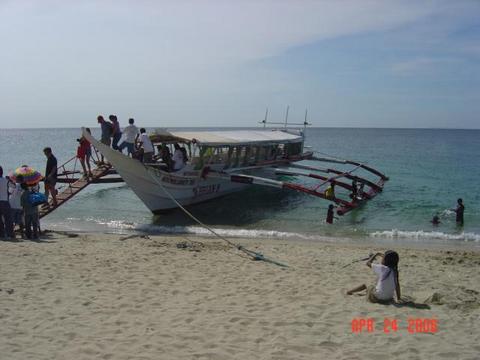
The first part of the one-hour crossing consisted of an uneventful treading of an all-blue expanse. Thankfully, it was sunny that day. There were constant waves, but not the towering ones. The wind blew just strong enough to keep us cool. The air wasn't really salty, and it was the cleanest I had inhaled for quite some time. Near Mindoro, we encountered about five islands not far from our boat. White sand adorned their edges and foliage crowned their center. We would quip that the boat may drop us there, in other words, "Para po, dyan na lang sa isla."

Finally, the boat throttled straight to a wide white strip of sand. White Beach slowly revealed its scintillating details. First to be discernible was the foliage behind the beach. The greenery covered the island's geography, which, like a natural wall, quickly climbed towards the clouds. Then there were the boats that were berthed on the white sand. Then the variety of beachside inns presented their facades. Then there were the people frolicking, swimming, idling by this marine wonder. The most pleasant of all, was the fact that the sea vessel we were riding was consistently surrounded by clear blue waters from a few kilometers away from the beach up to the few splashes on one's feet upon alighting. I'm gonna like this, I mumbled under my grin as I took in the scenery from the cloud-covered trees down to the sand that I could clearly see through the purest body of water I beheld in quite some time.

Indeed, there were pleasures big and small in White Beach. Some pleasures were obviously gastronomic. Numerous seaside restaurants serve generous amounts of grilled fresh seafood. Ah, nothing beats the rustic charm of simple provincial eateries and their home-cooked fare. The crowning glory of the food we ordered would be this seven-fruit shake consisting of mango, papaya, banana, cherry, melon and watermelon deliciously served with representative slices of the mentioned fruits adorning the rim of the tall glass. Ohhh yeahhh! Considering that fruit shakes had recently become my comfort food, consumption of this wonderful concoction left not just my stomach but more so my soul greatly fulfilled.

Another big thing was, of course, the boat ride to the snorkeling sites. In one site, the corals were farther out into the sea by about 20 meters from a remote beach. It was my first time to snorkel so I cannot do comparisons, but I sure heard myself say "whoa" underwater. It was a novel experience for me to see colorful and spiky fishes swimming in the wild. The other corals site was actually nearer to the beach. I mean, the corals were less than a couple of meters away from the shore! I never knew there could be coral reefs underneath waters so shallow. This second site had a larger area reef, where the senior ones among us gleefully explored. The others who dived vigorously in the first site were already tired. I wasn't so adventurous without the snorkel gear, so I just swam along the shore. Still, there were corals and exotic fishes along the fringes. When not swimming, I enjoyed the feel of large-grained sand between my feet. From 30 meters away, an excited yell startled everyone, "Dito! Maraming fish!" We never knew our boss, the soft-spoken leader of a soft-spoken team, can shout so loudly.

As for small pleasures, one of them happened after I chickened out of a banana boat ride since the tale of the Deadly Banana Boat Ride was fresh in my mind. I just swam around the crowded beach instead. Lo and behold! A submerged piece of paper that looked like money floated in front of my goggled eyes. I grabbed and inspected it and indeed it was a hundred peso bill! To be fair, I asked those swimming nearby if they had happened to lose 100 pesos to the sea. When they said no, well, this sea treasure financed my snack of isaw and my officemate's bottle of beer. Perhaps if I swam near the foreigners, I might snag a floating $100 bill, which was more than enough to pay for my total expenses in this trip.

Of the few things that I take issue from, one was the commercialization of this strip of white sand. Even with clear waters and white sand, serious nature trekkers would find it hard to take solace and commune with nature; since, it was as if a commercial district in Metro Manila was transported to the main beach. That was one more reason why the boat rides to the snorkel sites were more enjoyable: no crowds, no blaring music, no torturous videoke singers, and no smoke from dozens of barbecue grills from the numerous restaurants that line the beach. Speaking of restaurants, it would be wise to order even before the onset of hunger; because, the restaurants, or at most those we've tried out take a notoriously long time to cook those orders. Speaking also of crowds, it was not just people and establishments that crowd the main beach. Along the shores were docked boats awaiting snorkelers, and, even more irksome, were the outrigger ferries that regularly arrive and depart to load and unload passengers right on the beach. The swimmers would have to give way to these vessels: there was never a good time for an idyllic swim on the main beach.

Moving on, the important thing was that White Beach delivered on what I was expecting--clean and clear waters--and more. With nearby less crowded alternative swimming sites reachable by boat or by traversing rocks, the shortcomings are more than compensated. I'll be back, definitely.


Other parts of the series:
1 2 3 4 5

Photo Credits: The high-quality ones I got from what my boss shared in our internal website.

Labels: , ,

CLICK HERE FOR THE REST OF THE ENTRY

Saturday, July 15, 2006

Summer 2006 Escapades (Part 2 of 5)

Rainy days have come. What better time to let the summer sun shine once again, at least in our minds.

-oOo-

Nasugbu, Batangas

So much for "private seaside houses," my brother’s in-laws decided they'd have to enjoy the summer on a real beach. Their wide search had considered high-end ones with the works on water as well as on land. I learned the summer version of the word "opportunistic": in those high-end resorts, everything, and I mean everything that you might need and want while there, from bed sheets to badminton rackets, was for rent. Thus apart from the ten thousand-plus peso main fee, the resorts were raking in additional income per night or per hour. Oh well, I guess that's how it would have to be to survive in the tourism industry. Besides, we could take care of our logistical needs to avoid the additional fees.

In the end, our beach experience was banal as banal can be. We settled for one of those resorts that dot the beach-side boulevard along Nasugbu, Batangas. The resort was obviously not high-end, but at least it won't charge additional fees. We were booked for the Holy Week(end).

Now, this four-day weekend is the longest respite from work in this country, and, since it coincides with the summer season when everyone is in vacation mode, most people, or at least the Metro Manila working class families would spend this God-given free time at the beach or in Bagiuo City. Personally, I would prefer that people would return to their home province, and practice their respective traditional Holy Week rituals. In that way, I think the reconnection to one's own roots, one's own community, would make reflection and repentance more heartfelt. What choice did I have, however, last Holy Week? I was unable to secure a ticket to Naga City. The buses were now fully booked, and I didn't want to idle around Cubao bus station as a chance passenger. Besides, I was now one of those working class Manileños, so for once, I shall go with the flow of the unrepentant sinners out to have some hedonistic fun (relax folks, that was just an exaggeration).

Once again, we passed by Tagaytay, then onwards to Batangas. With a little help from the locals ("Ganire, gan-on," an old woman muttered while her arms' gesticulation hinted left turns; as to which street, and how far that was, we had to ask others along the way), we were at the boulevard, looking for our resort.

After settling down from unpacking food and utensils, we decided to check the beach out. The strip of sand was more than two kilometers wide, I suppose, but it was crowded by beachgoers, this weekend being the peak of tourist influx. The sand was black like in the “private seaside house”, but what disappointed me, though, was the murky water, which they say was due to its proximity to Manila Bay. I wasn't going to swim in this liquid where I couldn't see anything a few feet underneath. Instead, I contented myself with a very long stroll along the coast as the sun was setting into the waters (the beach was situated at the west of Luzon; thus, watching sunsets were as simple as looking straight out to the sea).

People-watching during the stroll had left me doubly disappointed with the dearth of human beauty. Sure there may be one eye-catching group or family after some ten meters or so, but I would prefer seeing one wherever I turn my gaze (the two places where that happens are at the Powerplant Mall and the Ateneo Loyola Schools). I might as well have gone to Boracay (and see the same people frequenting Powerplant and studying at the Ateneo). There was not even a single familiar face in here. It seemed my friends knew better than to get stuck in some beach that had seen better times.

The one reward I had for my kilometers-long stroll was stumbling upon the mouth of the river, the source of all that black sand. Its water was just as dirtied, carrying the waste coming from some Batangas town(s). Nevertheless, the geek in me enjoyed standing at the point where fresh water met salt water, their currents countering each other. I wished I had brought my camera-phone to capture this moment, grainy photo or not. I wished for the camera-phone again to capture the moment the jet skier passed right beside a reddish sun hanging low on the horizon. When the sun's disc touched the horizon, it took less than a minute for it to be completely under the blue expanse of the sea.

I did my swimming in the pool of our resort. Thank goodness for their providing a clean body of water albeit man-made. Just that I had to watch out for the transvestite with fake(?) boobs who'd been soaking in the pool for hours, like an alligator waiting for its prey.

The highlight of the entire trip happened later that night...


Other parts of the series:
1 2 3 4 5

Labels: , ,

CLICK HERE FOR THE REST OF THE ENTRY

Sunday, July 09, 2006

Summer 2006 Escapades (Part 1 of 5)

Rainy days have come. What better time to let the summer sun shine once again, at least in our minds.

-oOo-

Earning their own salary enables people to splurge in their personal luxuries. The most common of these financial black holes would be clothes, shoes and accessories. Others reward themselves to a massage, as spa or perhaps a beauty treatment. The techies would gobble up the latest gadgets, while others still go for their comfort food, or any delicious food for that matter.

I don't know if I can consider myself lucky to not have the above types of luxuries that demand a regular share of the monthly income. My luxury is seasonal and highly dependent on my leaves and work schedule. There is also the high possibility that it can get cancelled, one reason being the other participants' inability to raise funds due to the demands of their regular indulgence. These factors allow me to save more money for my future stability and my future of more lavish luxuries (I wish!). Talk about delayed gratification! On the other hand, when all the factors like time, weather, logistics and funds are in cosmic balance, I then indulge in my personal luxury: the vacation trip.

The summer season from March to May (expanded to February-June) is the perfect opportunity for these trips. With newly available vacation leaves and last year’s savings at my disposal, I was all set to grab that opportunity last Summer 206 and lavish myself with a trip to the beach or any swim-able body of water for that matter...

-oOo-

"Private Seaside House" in Batangas

My brother's in-laws were invited to their friend's "seaside house" somewhere in Batangas. To go there, one passes through the same route as one would go to Nasugbu. The extended family, as well as family friends, answered the invitation. Nothing beats the lure of a "private seaside house"; we were imagining the freedom and the perks this house would provide to us. What surprises could be in store for us?

We started the excursion one February morning. In the South Expressway, we took the Sta. Rosa exit, allowing us to pass by Tagaytay. The morning air in this city is pleasantly aircon-cool. Going down from the Taal Caldera, the next part of the trip was a long uneventful drive.

In a Batangas highway, our host drove up with his pickup to meet us and to guide us to his place (we were starting to get lost). Along the way, we dropped by his friend's resort, which was more famous in the past as the location for a kenkoy movie. Sadly, the resort had lost whatever glory it had, for it now appeared as a mere run-of-the-mill resort. The owner conceded that a power plant nearby had affected beachgoers perceptions. Fortunately, we're not staying in a resort, but in a "private seaside house."

After the resort, we approached the colossal structures of the coal power plant the resort owner mentioned earlier. To our great surprise, our host turned to the entrance of that plant. We beheld up close how giant shovels would haul coal from a docked cargo ship, place it in giant conveyor belts, which in turn would dump their load beside the plant, creating mountains of coal. From these mountains, the coal would then be placed in another giant conveyor belt that would feed them into the plant itself, fuelling the giant generator that creates electricity. Man, everything was huge in here!

Our vehicle convoy stopped at a bungalow located just outside the plant complex. It turned out that our host is the contractor for the coal-mining and delivery to this power plant. Yup, his company owns the cargo ship docked nearby. The bungalow was the rest house for the crew while the coal was still being unloaded. Okay, so we would be staying here, fine, I guess the aircon would filter out the coal dust that was now sticking to my skin. If we'd still have to drive to the swimming area, that's fine by me, as long as it would be away from this place.

Unfortunately, this was actually the "seaside house," meaning, we'd be swimming nearby, right beside this coal power plant. Indeed, after a couple of minutes' walk, we encountered what appeared to be a miniscule "beach" with black sand and a floating hut. They said the sand was black not because of the coal, but because of volcanic deposits from a nearby river. I still took issue with the sand though; because, under water, it turned into something like coarse mud. The sanded area of the "beach" was a puny 20-meter stretch from side to side and a pathetic three-meter skip-and-hop towards the water. The water by the "beach" was enclosed like a tiny "bay". The water, though, was clear since I could still see the little fishes swimming below. It was actually a good sign that fauna thrives here, like the small crabs and snails crawling up the hut and the school of flying fish doing their aerial leaps a few meters away. The water itself wasn't too salty and didn't give me an itch.

The floating hut became our dining area. The seniors share their stories after some drinks. One couple had to take care of their toddler. The young couples, on the other hand, wandered away on a banca, sharing romantic moments while rowing around the enclosure. As for the singles like me, we contented ourselves with some swimming as well as with partaking of the abundant food.


Other parts of the series:
1 2 3 4 5

Labels: , ,

CLICK HERE FOR THE REST OF THE ENTRY

Wednesday, June 07, 2006

Toxic


The metro atmosphere is toxic. Aside from the ambient air along EDSA, JP Rizal, Kalayaan and C5 being filled with abnormally and sinfully huge amounts of particulate matter and pollutants, my nightly commute is punctuated, first with an olfactory barrage from the garbage of Guadalupe Commercial Complex. The stink is most profound around 10pm when they are shoveling their trash into a dump truck. Every scoop of the shovel releases more hidden smelly terror, making the air around the alley where the jeepney passes sourer than a thousand sweaty armpits. The second brutal nose assault happens along C5 Palar. Their own version of smelly garbage makes me wonder how food vendors nearby can still sell their contaminated wares. Every time I pass these biohazard areas, I hold my breath rather than cover my nose, which the other passengers would do. I hold my breath like in diving since I consider it useless to merely filter the air with cloth since this would be akin to using the same cloth to filter out water to breathe under the sea. Yes, that's how bad the air is here. I feel like acquiring lung cancer or some respiratory disease even though I don't smoke.

As if the atmospheric abuse can't get worse, somebody was burning tires big time one night ago. Noxious tire fumes spread out over such a large area that I was gasping for air like a fish out of the water. As if burning tires wasn't against the law. But what the heck is the use of such a trivial law as the Clean Air Act in the Philippines? If the crime isn't as immediate as murder or rape or robbery, Filipinos normally won't give a shit. Yeah, we'll die just like the frogs that fail to realize that the water temperature in their pool is slowly being raised to fatal levels.

For once, I wish the law of the real jungle would prevail in this urban jungle. This is natural justice: if you do one thing, another will surely follow. A disruption in the circle of life will return to the culprit. Unfortunately, in this artificial world, catastrophe can be delayed unnaturally, giving humans complacency. But with the damage remaining unchecked, catastrophe will come. There might come a time people would just drop dead because of the poisonous air. Buildings, statues and other monuments would have accelerated corrosion.

I am just talking about the air, but the water and the land have their share of pollution. Somehow I feel like welcoming this environmental Apocalypse that we would bring upon ourselves. Hopefully, I'll be watching the end of Metro Manila unfold via TV in the comfort of my provincial home.

Labels: ,

CLICK HERE FOR THE REST OF THE ENTRY